

Market Insights | November 2026 | 7SEtronic
Table of Contents
Texas Instruments TI automotive chips 2026 have become a major topic in the electronic components spot market. Buyers are reporting increased inquiries, wider price differences, and tighter availability for selected Texas Instruments automotive part numbers.
Some distributors describe significant price increases, while others report that inquiries are rising faster than actual orders.
Meanwhile, Texas Instruments has reported strong financial results, with automotive demand contributing to its recovery.
So, is the market experiencing a genuine supply shortage, a demand-driven recovery, or a temporary wave of speculative pricing?
The answer is more complicated than the headlines suggest.
1. TI Automotive Chips 2026: What’s Happening in the Spot Market?
Since approximately July 2026, market participants have reported growing interest in selected TI automotive components.
According to industry observations circulating in the Chinese electronic components market, the momentum developed gradually:
- July–August: Early signs of stronger demand and longer lead times for certain automotive components.
- September: More reports of price increases and tighter availability for selected devices.
- October–November: Greater spot-market activity, wider quotation differences and more frequent sourcing inquiries.
However, this does not mean every TI automotive component is in short supply.
Demand appears uneven across product families, and availability can differ substantially between individual orderable part numbers.
Some distributors report successful transactions at higher prices. Others describe an increase in inquiries without a corresponding rise in confirmed purchase orders.
This distinction matters.
A higher quoted price does not necessarily mean the market is consistently transacting at that level.
In a volatile market, the difference between an asking price and a completed transaction can be substantial.
2. Which TI Components Are Attracting Attention?
Market discussions have mentioned several TI product families, particularly those associated with power management, automotive interfaces and switching applications.
Examples include:
| TI Product Family | General Function | Reported Market Observation |
|---|---|---|
| LM74700 | Ideal-diode controller | Selected variants mentioned in price-increase discussions |
| LM5148 | Synchronous buck controller | Reports of higher quotations and sourcing difficulty |
| DRV8718 | Motor driver | Selected devices attracting sourcing inquiries |
| TPS4H160 | High-side switch | Reports of tighter availability for certain variants |
Note: These are examples from market commentary, not a verified list of universally short-supplied products. Current availability and pricing must be checked against the exact orderable part number.
Another important distinction concerns automotive qualification.
Many TI automotive-qualified devices use a -Q1 designation. However, buyers should verify the exact manufacturer’s part number and its qualification documentation rather than assuming that a similar-looking part is interchangeable.
An industrial-grade component and its automotive-qualified counterpart may differ in qualification, operating conditions, documentation or other requirements.
For automotive production, an apparent alternative should never be approved based on price or package similarity alone.
3. TI’s Financial Results: What Do the Numbers Tell Us?
While spot-market discussions have become increasingly active, TI’s official financial results provide a more reliable view of broader business conditions.
Texas Instruments reported the following results:
| Financial Metric | Q2 2026 | Q3 2026 |
|---|---|---|
| Revenue | $5.46 billion | $6.06 billion |
| Year-over-year revenue growth | 23% | 28% |
| Net income | $1.98 billion | $2.43 billion |
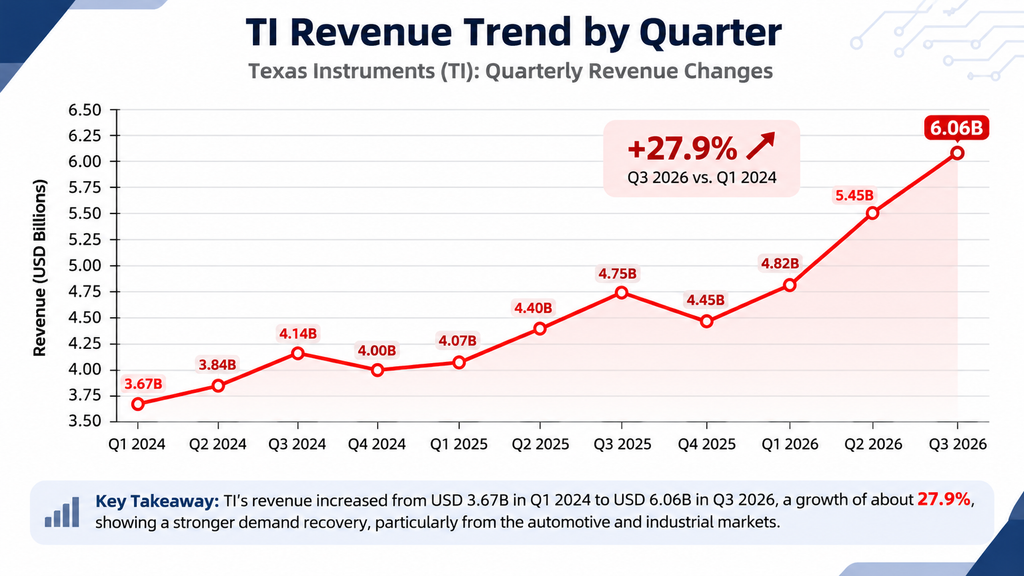
Sources: Texas Instruments Q2 and Q3 2026 earnings releases.
TI reported broad growth across its industrial, automotive and data center markets.
In its third-quarter announcement, the company reported an 11% sequential increase in revenue and 28% growth compared with the same quarter of 2025.
This is an important signal: the recovery is supported by broader end-market demand, not merely by activity in the independent distribution market.
Automotive Demand Is Part of the Recovery
Automotive has long been a strategically important market for Texas Instruments.
Modern vehicles require a wide range of analog and embedded processing components for applications such as:
- Battery management and power conversion
- Electric and hybrid vehicle powertrains
- Body electronics and lighting
- Motor control and sensing
- Vehicle connectivity and electronic control systems
The increasing electronic content of vehicles creates long-term opportunities for semiconductor suppliers.
However, stronger automotive revenue does not automatically imply that every automotive component is experiencing a shortage.
Demand can rise across a broad product portfolio while individual part numbers experience very different supply conditions.
4. Inventory Is Declining, but Does That Mean TI Has a Shortage?
Inventory is another useful indicator.
According to TI’s third-quarter 2026 regulatory filing, its days of inventory decreased from 222 days at the end of 2025 to 194 days in Q3 2026.
This decline is consistent with improving inventory utilization and stronger business activity.
Nevertheless, company-wide inventory figures cannot establish the availability of an individual component.
A semiconductor manufacturer may hold substantial overall inventory while having limited stock of a specific package, grade or orderable variant.
For procurement teams, the key question is not simply whether TI has enough inventory overall.
It is:
Can the exact required part number be supplied in the necessary quantity, within the required delivery schedule?
This is especially important when the component is already approved for automotive production and changing suppliers or devices would require additional qualification.
5. Why Are Spot-Market Prices So Different?
One of the most noticeable features of the current market discussion is the wide variation between quotations.
Several factors may contribute.
Limited Availability of Specific Part Numbers
Supply constraints can be concentrated in particular products, packages or orderable variants.
A shortage affecting one device does not necessarily extend to an entire product family.
Differences Between Inventory Sources
Independent distributors may source components through different inventory holders, regions and supply channels.
Consequently, two suppliers quoting the same part number may have significantly different acquisition costs.
Short Quotation Validity
When market conditions change quickly, suppliers may provide quotations valid for only a short period.
A quotation should not be treated as a guaranteed allocation unless the stock, commercial terms and reservation conditions have been confirmed.
Speculative Market Activity
Expectations of future shortages can influence pricing behavior.
However, exceptionally high offers should not be interpreted as representative market prices without evidence of actual transactions.
For buyers, this makes supplier verification and quotation comparison particularly important.
6. Five Sourcing Strategies for OEM and EMS Buyers
Rather than reacting to every price increase, procurement teams should focus on controlling risk.
1. Verify the Exact Manufacturer Part Number
Confirm the complete orderable part number, including package, automotive qualification and other relevant suffixes.
Do not assume two similar part numbers are interchangeable.
2. Separate Confirmed Inventory from Indicative Offers
Ask whether the quoted quantity is physically available, subject to allocation or dependent on another supplier’s confirmation.
Confirm the expected shipping date before placing a purchase order.
3. Check Date Codes and Traceability
For sensitive applications, request relevant information such as date code, lot details, packaging condition and available traceability documentation.
Where appropriate, consider independent quality inspection.
4. Evaluate Alternatives Early
When a component becomes difficult to source, engineering and procurement teams should work together to evaluate possible alternatives.
For automotive applications, electrical compatibility alone is insufficient. Qualification and approval requirements must also be considered.
5. Plan Critical Purchases Before Production Is Affected
Review critical BOM items, supplier lead times and inventory coverage regularly.
Early sourcing discussions can provide more options than urgent last-minute purchasing.
7. How 7SEtronic Supports TI Component Sourcing
At 7SEtronic, we work with OEM, EMS and electronics procurement teams to source Texas Instruments components, including hard-to-find, long-lead-time and obsolete parts.
Our sourcing support includes:
- TI part-number sourcing and availability checks
- BOM consolidation and multi-part quotations
- Flexible minimum order quantities where available
- Alternative component sourcing support
- Quality verification and third-party inspection options
- 365-day warranty on supplied components
Our focus is to help customers identify realistic purchasing options, verify available supply and reduce unnecessary procurement risks.
We do not believe every market rumor should trigger an urgent purchase.
Instead, buyers should evaluate the actual availability, commercial terms and quality requirements of the specific components they need.
Conclusion: A Stronger Market, but Not a Universal Shortage
The renewed attention surrounding TI automotive semiconductors reflects a combination of stronger end-market demand, changing inventory conditions and increased spot-market activity.
TI’s financial performance confirms a broad business recovery, including growth in automotive applications.
At the same time, unusually high spot quotations and reports of shortages should be evaluated at the individual part-number level.
For OEM and EMS buyers, the most effective response is not panic buying.
It is accurate part-number verification, early supply planning and working with sourcing partners who can provide transparent information.
For buyers navigating the TI automotive chips 2026 market, the priority should be verifying actual stock, confirming exact part numbers and traceability, and comparing realistic lead times rather than reacting to unusually high spot-market quotations.
For OEM and EMS buyers, early supply planning and working with reliable sourcing partners remain more effective than panic buying.
Looking for TI Components?
Whether you need a common TI device, a hard-to-find automotive component or support with a complete BOM, 7SEtronic can help review your sourcing requirements.
Search TI Components: https://ti.7setronic.com/
Request a Quote: info@7setronic.com
Market note: This article combines publicly reported manufacturer information with observations from the independent electronic components market. Market observations are not official TI statements. Prices, stock and lead times are subject to change and should be reconfirmed before ordering.
References
- Texas Instruments, Q3 2026 Financial Results, October 21, 2026.
https://www.ti.com/en-us/about-ti/newsroom/news-releases/2026/2026-10-21-ti-reports-third-quarter-2026-financial-results-and-shareholder-returns - Texas Instruments, Q2 2026 Financial Results, July 22, 2026.
https://www.ti.com/en-us/about-ti/newsroom/news-releases/2026/2026-07-22-ti-reports-second-quarter-2026-financial-results-and-shareholder-returns - Texas Instruments, Q3 2026 Form 10-Q.
https://investor.ti.com/node/38646/xbrl-viewer - Texas Instruments, Part Ratings and Automotive Qualifications.
https://edgeworker.ti.com/en-us/quality-reliability/certifications-standards/part-ratings